

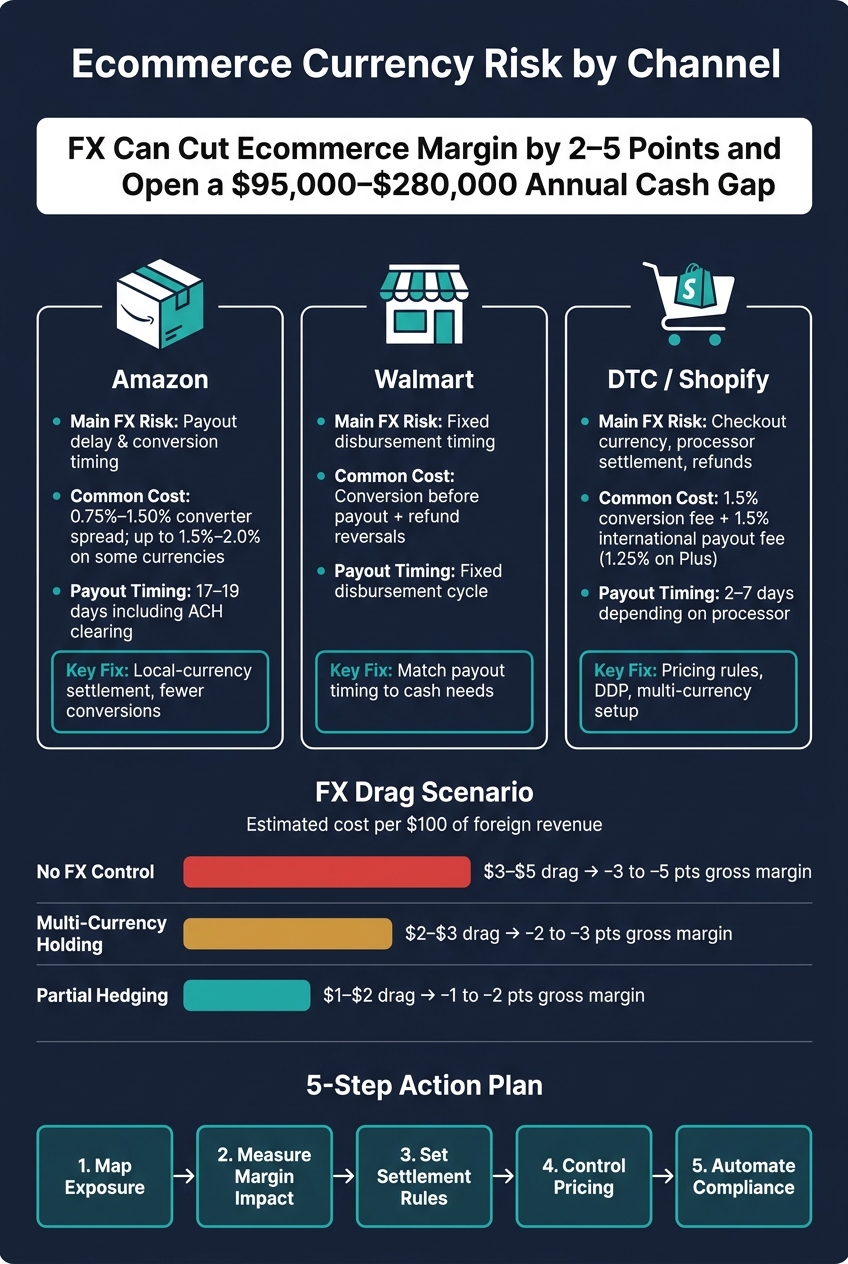
FX can cut ecommerce margin by 2 to 5 points and open a $95,000 to $280,000 yearly cash gap. If I sell on Amazon, Walmart, and Shopify, I need to track where foreign currency comes in, when it converts, what fees apply, and when suppliers must be paid.
Here’s the short version:
- Amazon and Walmart mostly create FX risk through payout timing and conversion before disbursement
- DTC stores face FX risk through checkout currency, processor fees, payouts, and refunds
- Small costs stack up fast: a 1.5% to 3.0% FX drag can eat into margin without showing up as one clear line item
- Shopify fees matter: U.S. stores can face a 1.5% conversion fee plus a 1.5% international payout fee on some flows
- Timing gaps hurt cash flow when foreign sales settle after USD supplier invoices are due
- I can cut the leak by using multi-currency accounts, local-currency payouts, fixed pricing rules, and matching foreign revenue to foreign expenses
If I had to boil it down even more, it would be this: map every foreign-currency inflow and outflow by channel, amount, and settlement date, then cut extra conversions and price for the cost that remains.
Quick comparison:
| Channel | Main FX risk | Common cost pressure | Main fix |
|---|---|---|---|
| Amazon | Payout delay and conversion timing | Converter spread, fees, reserve holds | Local-currency settlement, fewer conversions |
| Walmart | Fixed disbursement timing | Conversion before payout, refund reversals | Match payout timing to cash needs |
| DTC / Shopify | Checkout currency, processor settlement, refunds | 1.5% conversion fee, payout fee, refund FX loss | Pricing rules, DDP, multi-currency setup |
That’s the core issue and the fix: find the FX leak, measure it in dollars, and set channel rules so margin doesn’t slip sale by sale.
Ecommerce FX Risk by Channel: Costs, Timing & Fixes
Forex Risk Management: Strategies to Mitigate Currency Risk
sbb-itb-e2944f4
Map FX Exposure Across Amazon, Walmart, and DTC Stores
Start by mapping every foreign-currency inflow and outflow across Amazon, Walmart, and your DTC store. Look at the channel, the amount, and the settlement date.
That means more than marketplace payouts. You also need to track processor settlement, refunds, supplier payments, freight, and any foreign-currency ad spend. If money comes in or goes out in another currency, it belongs on the map.
Amazon and Walmart Payout Exposure
Amazon and Walmart both create FX exposure, but in slightly different ways.
Amazon payouts can be delayed by reserve holds and ACH clearing. Walmart pays on a fixed cycle. In both cases, the timing of conversion still matters. A few extra days may not sound like much, but when exchange rates move, those delays can turn into margin pressure and cash-flow strain.
DTC Checkout, Processor Settlement, and Refund Exposure
DTC gives brands more control over pricing. But the FX costs are still there, and they’re often easy to miss.
On Shopify, a 1.5% currency conversion fee applies to U.S.-based stores. There’s also a separate 1.5% international payout fee, or 1.25% on Shopify Plus, for non-domestic currency payouts. These charges can sit quietly inside reports and chip away at margin. The mix of fees and timing gaps can reduce net revenue without much warning.
Refunds and returns add another layer. If the exchange rate moves after the sale, brands can face refund-related FX risk. The problem gets worse with Delivered Duty Unpaid (DDU) shipping, where refused packages, returns, and chargebacks can create messy, hard-to-predict FX outflows. Delivered Duty Paid (DDP) makes the checkout amount final and cuts down refund-related FX exposure.
Build a Simple Exposure Map Before Taking Action
The goal is simple: create one document that shows every foreign-currency touch point across all channels.
For each exposure, list:
- Currency
- Channel
- Estimated amount
- Expected settlement date
That gives you a clear view of what matters most. Some exposures may be big enough to hedge. Others can be handled through pricing changes or by adjusting how and when you settle.
Use this framework to capture everything in one place:
| Channel | Settlement Currency | Payout Timing | Fee-Related FX Impact | Refund Handling | Supplier Payments |
|---|---|---|---|---|---|
| Amazon | Converted before payout | 17–19 days including ACH clearing | Marketplace fees and ad spend deducted before conversion | Refunds, chargebacks, and disputes can raise reserve requirements and delay payout | USD invoices due before payout creates timing gap |
| Walmart | Converted before payout | Fixed disbursement cycle | Marketplace fees deducted before disbursement | Refunds and disputes can trigger FX reversals or delayed disbursement | USD invoices due before disbursement creates timing gap |
| DTC (Shopify) | Store currency or up to 8 local currencies (Advanced/Plus) | 2–7 days, depending on the processor | 1.5% conversion fee + 1.5% payout fee | Higher FX risk under DDU; DDP helps stabilize costs | Foreign-currency vendor invoices add outflow exposure |
Once the map is built, you can sort exposures into two buckets: the ones you can fix with pricing or settlement changes, and the ones that may call for hedging.
How Currency Risk Cuts Profit and Strains Cash Flow
Once you’ve mapped your exposure, the next step is simple: put a dollar figure on what it’s doing to your margin and cash flow.
Margin Compression from FX Moves and Conversion Fees
In most cases, margin loss doesn’t come from one dramatic exchange-rate swing. It comes from small conversion costs stacking up over and over.
Take a U.S. brand selling in the UK. It collects GBP, then Amazon converts that money to USD at a rate that already includes a conversion fee. Amazon Currency Converter for Sellers charges 0.75% to 1.50% based on 12-month processed volume, and some currencies carry a flat 1.5% to 2.0% fee. Then, if that same brand pays suppliers in CNY or EUR, another spread gets added on top.
That chain of conversions can quietly strip out 2–5 percentage points of gross margin for every $100 in foreign-currency revenue across Amazon, Walmart, and DTC channels. Put differently, FX drag can average 5.9% of margin and open up a $95,000 to $280,000 annual cash gap.
This is why FX costs often slip under the radar. Nothing looks broken in a single report, but the money keeps leaking out.
Payout Timing Gaps and Supplier Payment Mismatches
Cash flow pressure usually starts with timing gaps, not just exchange rates.
A Q4 inventory order might call for 30% upfront and 70% on shipment, weeks before Amazon or Walmart sends the related payout. That turns FX into a working-capital issue fast. If the USD weakens against CNY between the purchase order date and the invoice due date, your cost of goods goes up in USD terms. At the same time, if EUR or GBP weakens before the marketplace payout lands, the USD value of those sales comes in below plan.
And of course, this tends to hit when cash is already tight. Peak season often brings heavier ad spend, bigger inventory buys, and more reorders. So you get pressure from both sides: supplier costs rise while sales proceeds shrink. The result is a working-capital squeeze that sales dashboards don’t show.
Measure the Impact with a Basic Margin Scenario Table
A simple scenario table helps you compare three paths: doing nothing, cutting conversion steps, or locking in known costs. The ranges below reflect common marketplace conversion fees, observed FX spread ranges, and benchmark margin impact data.
| Scenario | Estimated FX Drag per $100 | Gross Margin Effect | Cash Timing |
|---|---|---|---|
| No FX control (default marketplace conversion, no timing strategy) | $3–$5 | −3 to −5 percentage points | Low |
| Multi-currency holding (hold foreign-currency balances, pay some local costs directly) | $2–$3 | −2 to −3 percentage points | Medium |
| Partial hedging (forward contracts or locked rates for confirmed near-term supplier invoices) | $1–$2 | −1 to −2 percentage points | High |
Default marketplace conversion is easy, but it doesn’t protect margin. Holding GBP or EUR balances removes some conversion steps. Partial hedging can lock in known supplier costs for the near term.
Those gaps in cost and timing help show which exposures are worth repricing, netting, or hedging by channel.
Currency Risk Controls That Work for Ecommerce Brands
Once you’ve mapped your FX exposure, the next step is usually pretty simple: fix the operations behind it. That often means adjusting pricing, cutting forced conversions, and lining up receipts with payments.
For Amazon and Walmart, the main issue is usually payout timing. For DTC, the bigger issue tends to be pricing and processor settlement.
Pricing and Settlement Controls
Rules-based pricing can help keep local prices steady. Another option is to add market-specific markups to cover FX swings and conversion fees. This is mostly a DTC lever, but settlement routing also matters for Amazon and Walmart.
On the settlement side, forced conversions can chip away at margin through added fees. Multi-currency payouts or local-currency accounts can help cut those extra conversions.
Supplier Payment and Natural Hedging Controls
If you collect revenue in GBP and pay a UK-based logistics provider in GBP, you already have a natural hedge. The foreign-currency revenue offsets the foreign-currency cost, so you don’t have to convert both sides. That matters most when sales and supplier costs sit in the same foreign currency.
A practical move is to hold foreign currency in a multi-currency account and use it to pay matching suppliers or logistics providers directly.
Simple Rules for Near-Term Confirmed Exposure
For near-term confirmed exposure, convert only confirmed cash flows. In plain English: match foreign-currency receipts to the next known foreign-currency payment instead of converting twice.
These controls work best when they match the channel and the way currency moves through it. Amazon and Walmart mostly have payout-timing issues. DTC is mainly a pricing and processor-settlement issue.
| Control Method | Primary Benefit | Operational Complexity | Best-Fit Use Case |
|---|---|---|---|
| Fixed local pricing | Protects margins from daily FX fluctuations | Low | Brands selling in markets with volatile currencies |
| Multi-currency accounts | Avoids forced conversions and supports natural hedging | Low | Brands with international suppliers or multi-currency payouts |
| Natural hedging | Offsets FX costs without financial instruments | Low–Medium | Brands with matching foreign-currency revenue and expenses |
Build a Channel-Level FX Plan and Next Steps
One FX Playbook for Amazon, Walmart, and DTC
Once your exposure map is in place, the next move is simple: set clear rules for pricing, payout, and settlement in each channel.
That matters because FX issues rarely show up in just one spot. They can hit when you price a product, when a marketplace sends your payout, or when funds get converted behind the scenes. If the rules aren’t clear from day one, margin can slip little by little.
Start with the basics:
- Use platform analytics and international traffic signals to spot where FX exposure is highest.
- Build FX drag into pricing from the start.
- Use multi-currency accounts or local-currency settlement to cut forced conversions.
- Test demand before localizing pricing and settlement.
- Use DDP for cross-border checkout.
- Automate duty and tax handling so compliance costs don’t eat into margin.
- Set rounding rules before launch.
After that, the job becomes ongoing. Pricing, payouts, and inventory all need to stay in sync by channel so the plan holds up in day-to-day operations.
How Emplicit Can Support Execution

FX control works best when channel operations move together. Emplicit can help keep pricing, PPC, inventory, and account health aligned so FX rules are used the same way across Amazon, Walmart, and DTC.
Key Takeaways
Use this checklist to standardize FX controls across channels.
| Priority | Action |
|---|---|
| 1. Map exposure | Identify every foreign-currency touchpoint by channel, amount, and settlement date |
| 2. Measure margin impact | Quantify FX drag and conversion fees against gross margin by channel |
| 3. Set settlement rules | Use multi-currency accounts or local-currency payouts to cut forced conversions |
| 4. Control pricing | Build FX drag into pricing and set rounding rules before launch |
| 5. Automate compliance | Handle duty and tax workflows so costs don’t erode FX-sensitive margins |
Brands that treat FX as an operating rule set – not a one-time finance task – are in a stronger spot to protect margin and plan working capital with more confidence.
FAQs
How do I find my biggest FX leaks?
Start by comparing the exchange rate shown to customers with the rate that’s actually used at settlement. That gap is often where money slips away.
A common issue? Some platforms update their rates only once every 24 hours. If the market moves during that window, the rate a customer sees can drift from the rate used later when the payment settles.
It also helps to review your payout structure for hidden international conversion fees. Those charges can chip away at margin without showing up in obvious places.
Then look at checkout abandonment. If people are dropping off after they see the final price, that can be a sign that exchange-rate mismatches are hurting trust and costing you sales.
When should an ecommerce brand hedge currency risk?
An ecommerce brand should hedge currency risk when exchange-rate swings start eating into profit margins, especially if it sells across borders.
This matters even more when rates can move hard between the moment a customer sees a price and the moment funds settle. That gap can create "FX margin leaks." The same problem shows up when internal systems rely on stale exchange-rate data instead of live market values.
What is the best way to reduce refund-related FX losses?
Prioritize a Delivered Duty Paid (DDP) shipping strategy so duties, taxes, and fees are collected at checkout. That way, customers see the full landed cost upfront. It also helps cut down on refusals caused by surprise import charges, which are a common driver of returns and FX-related losses.
It also helps to use real-time exchange rate APIs and native multi-currency gateways. These tools keep the gap smaller between the price a shopper sees and the rate used at final settlement.