
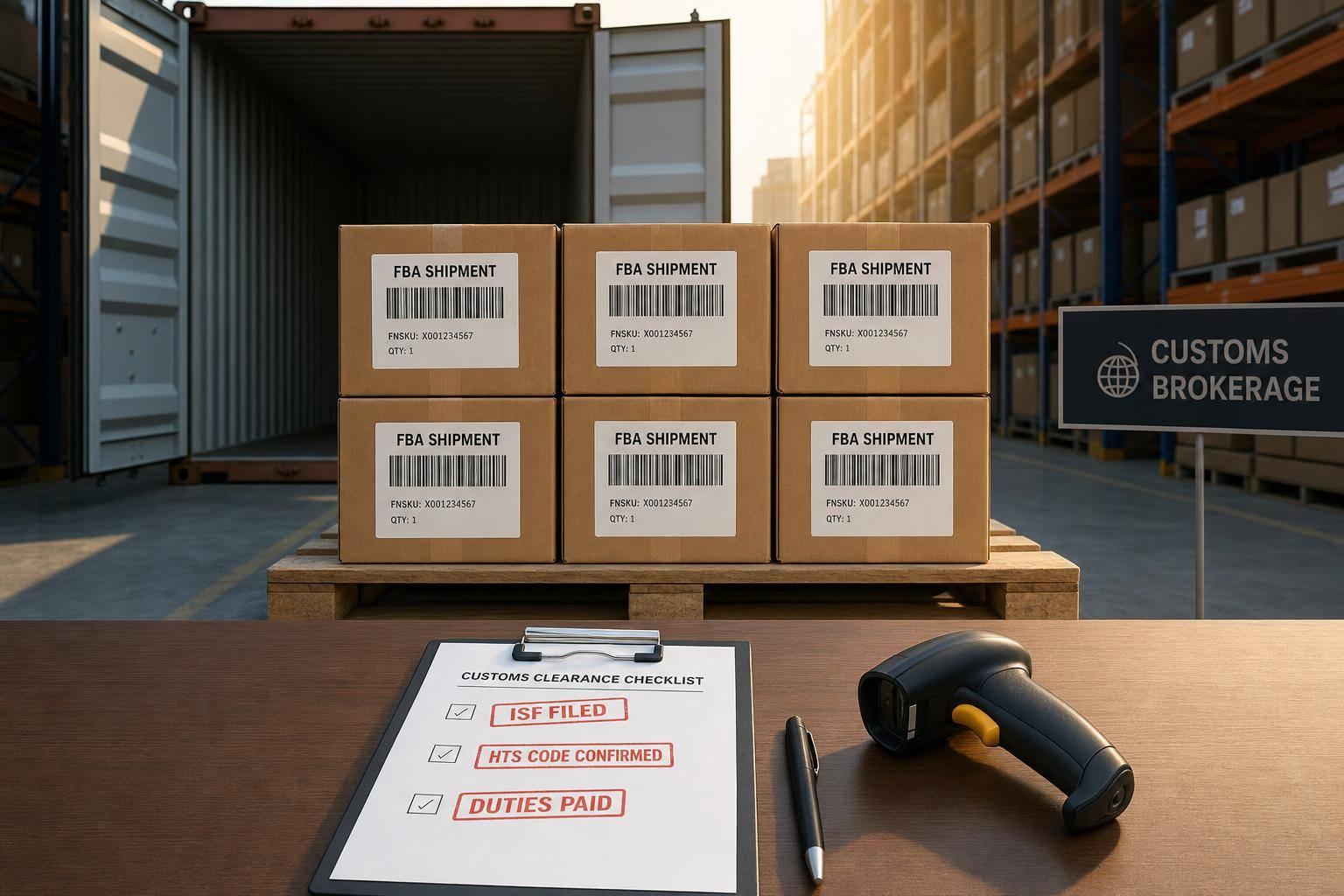
If your FBA shipment is not cleared, paid, labeled, and matched to your Amazon plan before the delivery slot, it can miss the appointment. That usually means extra storage, rebooking, and late inventory.
Here’s the short version: a customs broker helps me file entry data, handle ISF for ocean freight, pay duties and fees, answer CBP requests, and line up release with final delivery to the Amazon fulfillment center. Amazon is not the importer of record in the U.S., and Amazon will not pay import charges for me. That means I need prepaid shipping terms, clean documents, and the right importer details from the start.
Before I ship, I want these points locked down:
- Invoice, packing list, and B/L or AWB sent before departure
- Correct HTSUS code and country of origin for each product
- ISF filed at least 24 hours before ocean loading
- My EIN listed for the customs entry
- Amazon FC address and FBA Shipment ID matched across documents
- FNSKU, carton, pallet, and shipment labels matched to the plan
- Duties, taxes, and fees paid before release
- Carrier timing matched to the Amazon appointment
A missed step early on can turn into a port hold, exam, or missed receiving window later. In other words: brokerage is not just about customs – it also affects whether Amazon can receive the freight on time.
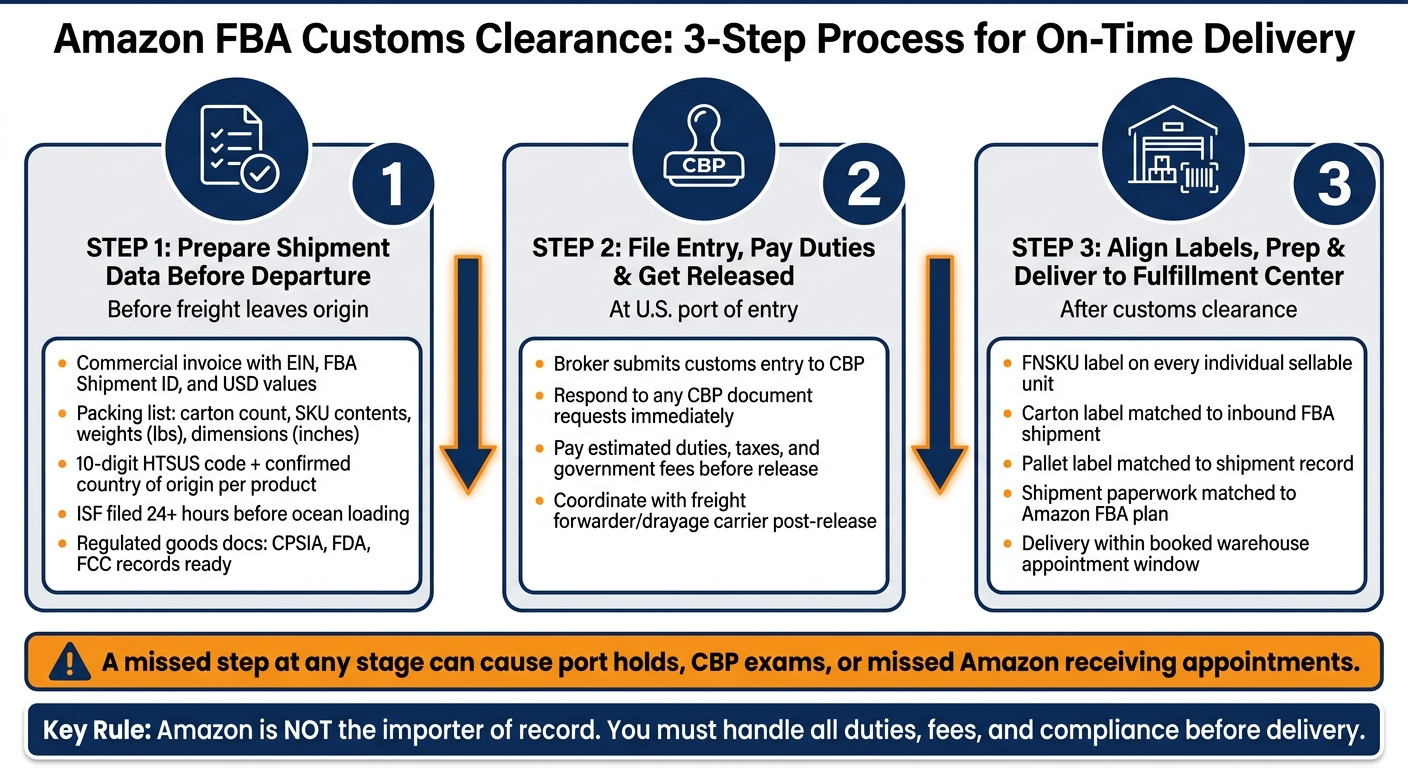
Amazon FBA Customs Clearance Process: 3 Steps to On-Time Delivery
Shipping from Alibaba to Amazon FBA Explained | How to Ship Products From China Tutorial

Step 1: Prepare shipment data before booking and origin departure
Before freight leaves origin, your broker needs clean, complete data to file the entry the right way.
Collect the documents your broker needs to file
Send your broker the commercial invoice, packing list, and bill of lading or air waybill before the cargo moves. These documents supply the data used for the customs entry.
The commercial invoice should show the buyer and seller names and addresses, a detailed product description, unit quantities and values in USD, total shipment value, country of origin, Incoterms, your IRS EIN or tax ID, the ship-to address listed as "In care of" the Amazon FC, and the FBA Shipment ID.
The packing list should line up with that invoice and include:
- Carton count
- SKU-level contents for each carton
- Net and gross weights in pounds
- Dimensions in inches
Your broker also needs the 10-digit HTSUS code and confirmed country of origin for each product type. Those two details affect the duty rate, show whether duty surcharges or trade remedies apply, and point to any extra compliance steps. A clear product description should cover material composition, function, and technical specs. That gives the broker enough detail to confirm or fix classification before the cargo arrives, instead of trading emails at the last minute.
If you’re shipping regulated goods, gather CPSIA, FDA, FCC, or warning-label records before booking. Waiting until the cargo is already on the water is one of the most avoidable reasons shipments get held after arrival.
Handle ISF and consignee details for ocean freight
For ocean shipments, your broker must file an Importer Security Filing (ISF 10+2) at least 24 hours before loading at origin. If the ISF is late or missing, CBP can issue penalties and the shipment is more likely to get pulled for a physical exam. That can throw delivery off and cause you to miss the Amazon warehouse appointment window.
The ISF needs the importer of record number, buyer, seller, consignee, manufacturer or supplier, ship-to party, container stuffing location, consolidator details, and HTS codes to at least 6 digits. The ship-to address must match the Amazon FC address in your FBA shipment plan. If Amazon changes the FC after you build the plan, update the ISF ship-to element before loading.
Your EIN goes on the entry as the importer of record number. If Amazon needs to appear as ultimate consignee, your broker must have Amazon’s approval and CBP identification before filing. Never leave the IOR field blank. CBP can refuse the shipment.
Confirm your shipment setup matches Amazon FBA receiving requirements
Finalize your Send to Amazon plan first. Then make sure SKU counts, carton totals, pallet details, and FC codes match across your invoice, packing list, and booking.
For split shipments, list each FC and the carton allocation in the broker entry notes.
When those details match, your broker can clear the entry and line up delivery.
Step 2: File the customs entry, pay duties, and get the shipment released
Once your freight is in transit or has reached a U.S. port, your broker files the customs entry and starts working to get the shipment released before your warehouse appointment date.
Submit the customs entry and respond to CBP issues
Your broker submits the customs entry to CBP. From there, CBP may release the shipment, ask for more documents, or choose to examine it.
You’re still responsible for the accuracy of the information you provide. That part matters more than many importers expect. Clean, complete documents can cut down on CBP follow-up. If CBP asks for more information, your broker will need your backup documents fast so the release process doesn’t stall.
Restricted goods need even faster replies, since CBP can hold those shipments for review.
Pay estimated duties, taxes, and government fees
Your broker calculates the estimated duties, taxes, and fees that need to be paid before release. Pay those charges right away to avoid delays.
Once CBP releases the entry, your broker can coordinate with your freight forwarder or drayage carrier for final delivery.
After release, the shipment moves to labeling, prep, and final delivery to the fulfillment center.
sbb-itb-e2944f4
Step 3: Align labels, prep, and final delivery to the fulfillment center
Once CBP clears the entry, Amazon’s receiving rules become the next gate.
Customs clearance gets the freight into the U.S. But Amazon still has to accept it. If labels or paperwork don’t meet Amazon’s rules, the shipment can be refused, put on hold, or hit with relabeling fees. Customs release only moves the freight to the next step. Amazon’s receiving rules decide if it gets to the dock on schedule.
Match FNSKU, carton, pallet, and shipment paperwork
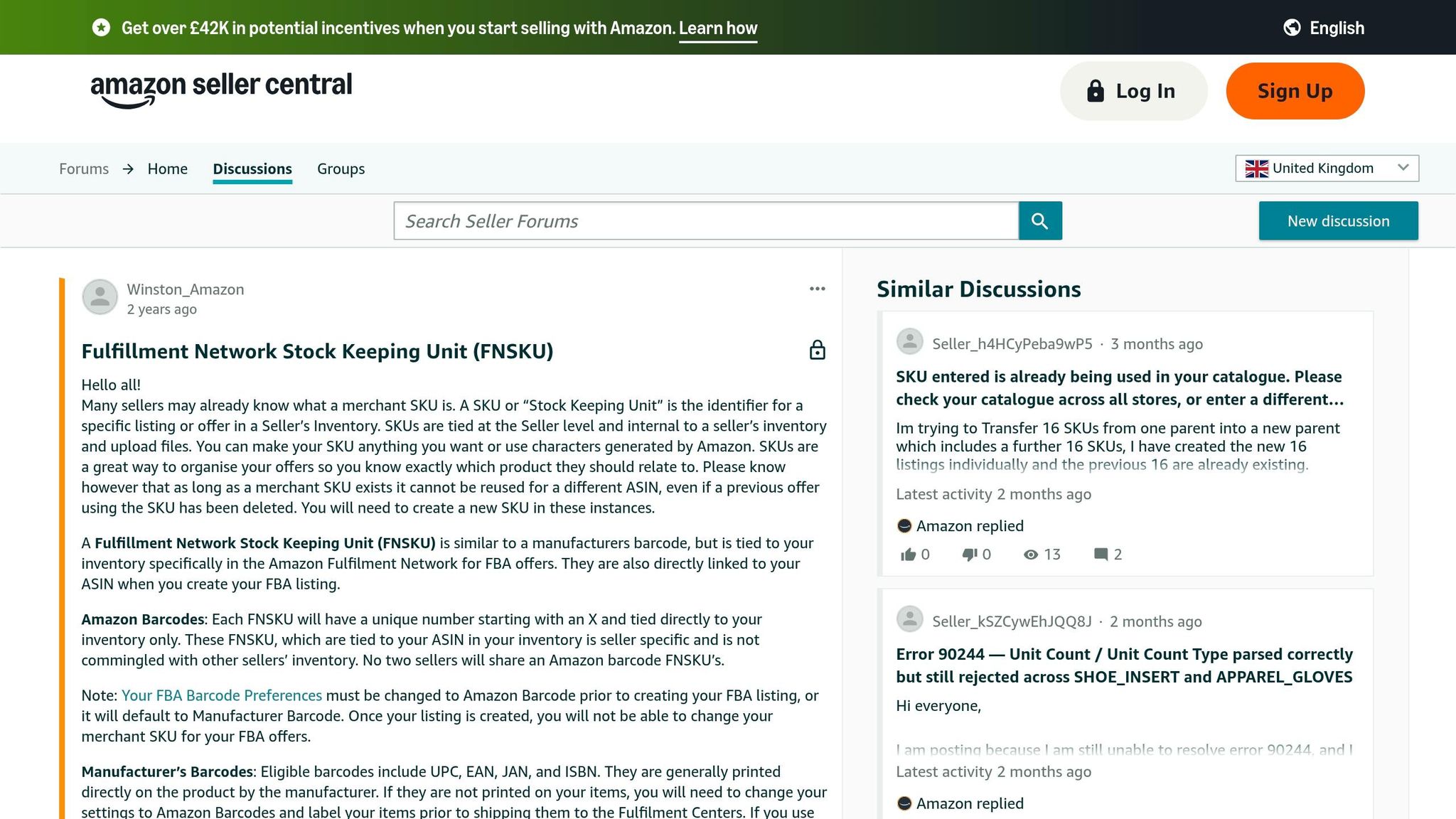
Every shipment label needs to line up with the FBA shipment plan. If your carton label doesn’t match the shipment record, or a unit is missing its FNSKU, that alone can cause a receiving issue. These items need to match:
| Label type | Purpose | Where applied | Common mistake |
|---|---|---|---|
| FNSKU label | Identifies each sellable unit for Amazon receiving and inventory tracking | On each individual unit when required by the FBA setup | Using the wrong barcode or covering the scannable area, causing the unit to fail receiving scan |
| Carton label | Links each box to the inbound FBA shipment for warehouse acceptance | On the outside of each shipping carton | Mixing carton labels across shipments or placing labels where they are hard to scan, blocking receiving |
| Pallet label | Identifies palletized freight so warehouse staff can match it to the shipment record | On the outside of each pallet | Missing pallet labels or labels that do not match the shipment record, stalling unloading |
| Shipment paperwork | Confirms shipment details used for receiving and delivery | Matched to the commercial invoice, packing list, and Amazon shipment plan | Carton counts, SKUs, or destination details that do not match the FBA shipment plan, triggering a receiving hold |
Carton counts and destination details also need to match the shipment plan so Amazon can receive the freight without a hold.
Coordinate release timing with drayage or final-mile delivery
After customs release is done, your drayage carrier or final-mile carrier has to move the freight into the fulfillment center within the booked window. If release happens late, the carrier may end up waiting around, and that can put the appointment at risk.
Work with your broker to confirm release status as early as possible so the carrier isn’t stuck idle waiting on paperwork. Port delays can eat into your delivery window fast.
Protect the warehouse appointment date
Missed delivery appointments are one of the easiest FBA delays to prevent. Most of the time, they trace back to a paperwork issue or a timing gap earlier in the process. Your broker should track release status, flag CBP issues early, and keep the carrier handoff on time.
That handoff is where brokerage helps stop customs delays from turning into missed appointments.
Conclusion: Use customs brokerage to cut avoidable FBA delays
Every step in the import flow affects whether your FBA inventory shows up on time. The goal is simple: clear customs on time and get inventory delivered in a state Amazon can receive without issues.
The main point here is simple too. Customs brokerage helps turn customs clearance into a planned step instead of a delay point. When reorder planning, inbound timing, and warehouse appointments are more predictable, your supply chain deals with fewer avoidable delays.
The best way to make this work is to repeat the same process shipment after shipment. Build a pre-shipment checklist with your broker, standardize your document handoffs, and review each shipment’s receiving outcome so you can tighten up the next one. Treat customs brokerage as part of your delivery plan, not a last-minute fix.
FAQs
Who is the importer of record for Amazon FBA shipments?
The search results don’t directly say who acts as the importer of record for Amazon FBA shipments.
What they do make clear is this: international sellers are responsible for customs paperwork, compliance, and filing accurate information with customs.
In practice, many sellers work with customs brokers to handle entry filings and duty payments. That can help cut down on delays and keep shipments moving.
What happens if my ISF is filed late?
A late Importer Security Filing (ISF) can create both operational and financial problems.
On the operational side, it can lead to shipment holds at ports or border crossings, along with transit delays. On the financial side, it can also result in fines.
For ecommerce businesses, the ripple effect is hard to ignore. Delays can trigger inventory stockouts, push up bonded warehouse storage fees, and weaken customer trust when orders arrive late.
Can Amazon reject a shipment after customs release?
Yes. Clearing customs and paying duties does not mean Amazon will accept the shipment.
Amazon still inspects inbound shipments based on its own rules. So even if your goods make it through customs, Amazon can still refuse them if they don’t meet FBA requirements.
For example, Amazon may take action if:
- FNSKU labels are missing, unreadable, or wrong
- prep requirements, such as proper poly-bagging, aren’t met
If that happens, Amazon may reject, return, or dispose of the shipment at the seller’s expense. It may also charge inbound defect fees.