

If you want regional links to drive sales, send them to the right local page. A link from Germany should go to your German page or Amazon.de listing. A link from Texas should go to the U.S. page, product page, or local campaign page that matches that audience.
Here’s the short version:
- Regional link building is about local relevance, not just domain strength
- Your page setup matters first: ccTLDs, subfolders, and subdomains each work differently
- Subfolders often make the most sense for brands entering multiple markets because links help one main domain
- Language, anchor text, and landing page must match the region
- Amazon links should point to the correct marketplace like Amazon.com or Amazon.co.uk
- Walmart and Target work best with U.S. local media, metro sites, and niche publishers
- Tracking by country, state, and marketplace URL is how you find which regions turn traffic into revenue
A few points stand out. First, outside links do not directly push Amazon rankings the way Google links affect a brand site. But they can send shoppers who are ready to buy, and that can help sales velocity. Second, a weak local landing page can waste the value of a regional link. If pricing, units, language, or shipping details feel off, users leave. Third, regional growth should be measured by CTR, conversion rate, AOV, referral traffic, and revenue by market.
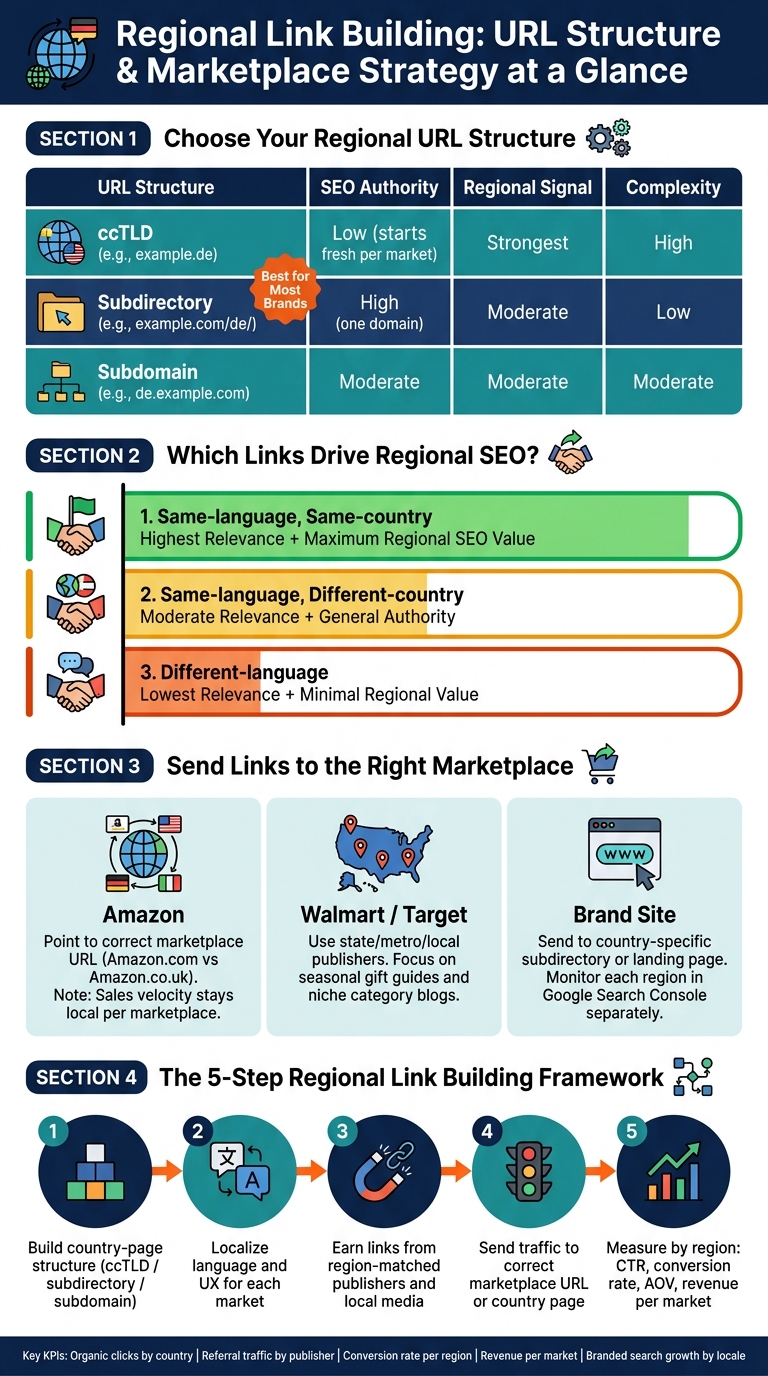
Regional Link Building: URL Structure & Marketplace Strategy at a Glance
3 Link Building Techniques That Still Work (Local, SaaS & Any Industry)
sbb-itb-e2944f4
Quick Comparison
| Area | What matters most | Main risk |
|---|---|---|
| Brand site SEO | Local page match, hreflang, regional links | Sending links to the wrong language or country page |
| Amazon | Correct marketplace listing, sales velocity, referrals | Sending all traffic to Amazon.com |
| Walmart / Target | U.S. state and city relevance, local publishers | Relying only on national press |
| Page structure | Strong URL mapping and local UX | Splitting authority across too many sites |
| Measurement | GA4, Search Console, UTM tracking | Looking at traffic without conversion data |
The core idea is simple: I’d treat regional link building as a page-matching and traffic-quality job, not just a link-count job.
Build the Right Regional Landing Structure First
Before outreach begins, get clear on where each regional link should go. If a German backlink points to your English homepage, the regional signal gets diluted.
Choose between ccTLDs, subdirectories, and subdomains
Each setup comes with a trade-off: domain authority, local relevance, and upkeep.
| Architecture | Example | SEO authority | Regional signal | Operational complexity |
|---|---|---|---|---|
| ccTLD | example.de | Low – each market starts with separate authority | Strongest local signal | High – separate link profiles per market |
| Subdirectory | example.com/de/ | High – all equity stays on one domain | Moderate – relies on hreflang and localization | Low – single domain to manage |
| Subdomain | de.example.com | Moderate – semi-independent | Moderate | Moderate – can use a different CMS |
For most brands moving into three or more markets, subdirectories are the practical choice. Every regional backlink you earn helps the same root domain. Nike uses nike.com/de/, so links to the root domain support the German subfolder.
ccTLDs can work well if you have the budget to build and manage separate link profiles for each country. If not, you’re starting from zero authority in every new market.
Once your regional URL structure is locked in, map each backlink to the right page version.
Map link targets by region and intent
A regional backlink should send people to the localized page, not the global homepage. If it doesn’t, you weaken local relevance and send users to the wrong place.
Hreflang also needs to line up with the linked URL. When backlinks and hreflang tags point to different page versions, search engines may give more weight to the backlink signal than the tag. In plain English: if a German link points to your English page, Google may show the English version in German search results.
"Don’t treat your global link building as one ‘universal campaign’. Instead, map link targets per URL version." – Arthur Andreyev, CMO, SEO PowerSuite Ltd
Use the x-default hreflang attribute to send users from unspecified regions to a global landing page or a language selector.
Localize page details that improve engagement and natural links
A regional link only works if the landing page feels right for that market. Publishers are more likely to reference pages their audience can use without friction.
That means localizing the details people notice fast:
- Prices
- Dates
- Units
- Temperature formats
Pages outside the U.S. should match local norms. A German page that shows product dimensions in inches instead of centimeters looks careless to both readers and editors.
Translation alone isn’t enough. Localize examples, visuals, and page details too. Those assets give regional publishers something worth citing, and that’s often what helps you earn local backlinks.
With landing pages lined up, outreach can match the language, search context, and buying habits of each region.
Match Language and Outreach to the Region
Publish content that fits local language and buying context
Landing pages that sound native tend to earn more regional links than plain translations. Local editors are far more likely to link to content that feels built for their market, not copied over by a machine.
That applies even across English-speaking markets. Product terms change by region, so your anchor text, page copy, and outreach keywords should match local usage.
Adobe‘s localized German report earned 175 local backlinks, which shows how market-specific adaptation can pull in regional publishers.
"Poor translation signals low effort. Native-level adaptation shows quality, and that is what publishers link to." – Andrew Shum, Head of SEO, SeoProfy
Use that localization work to go after in-market publishers first. After that, move outward to broader authority sources.
Same-language vs. cross-language links: pros and cons
For regional link acquisition, same-language, same-country links should come first. Here’s how the main link types stack up:
| Link Type | Relevance | Authority | Regional SEO Value |
|---|---|---|---|
| Same-language, same-country | Highest | Strongest local signal | Maximum; reinforces local presence |
| Same-language, different-country | Moderate to high | Moderate | Useful for general authority, but needs geo-targeting signals like hreflang |
| Different-language | Lowest | General domain authority only | Minimal for regional rankings |
Same-language, different-country links can still help build authority, but they don’t send the same regional signal. Cross-language links usually do little for local rankings.
Once you’ve picked the right regions and language pairs, the next step is to line up anchor text with the intent behind the search.
Match anchor text and landing pages to user intent
Write anchor text the way people in that market would actually say it. Don’t just translate English keywords word for word. A German link with English anchor text feels off to both editors and users.
The landing page matters just as much. If someone clicks a link in a German article and lands on an English page, there’s a good chance they’ll bounce. Send both the backlink and hreflang to the same local URL. The anchor text and landing page should match the same local intent.
When that lines up, regional outreach gets much easier to direct to Amazon listings, marketplace pages, or brand-site country pages.
Regional Link Building Tactics for Amazon, Walmart, Target, and Brand Sites
Once your pages and outreach are localized, the next step is simple: match each region to the right marketplace or country page.
Amazon: send regional traffic to the correct marketplace listing
Don’t send every regional link to Amazon.com. Send each region to its matching marketplace URL.
"Amazon SEO is global in structure, but local in execution." – beBOLD Digital
Each regional placement should point to the right marketplace URL. Sales velocity and reviews stay inside each marketplace, so Amazon.com performance does not transfer to Amazon.co.uk. If a regional link drives purchases on the correct marketplace, it helps build that local ranking signal from day one.
For outreach, go after regional buying guides, product review blogs, and niche publishers that already talk about Amazon products. Include the correct marketplace URL in your pitch, along with localized product terms. Amazon Brand Stores can also work well when a broader editorial mention makes more sense than a single product link.
Walmart and Target: use US regional media, community sites, and niche publishers
For US-first marketplaces, local depth matters more than cross-border reach. That means looking past national publications and putting more effort into state-level and metro-level sources.
Local press, city lifestyle blogs, chambers of commerce, neighborhood community sites, and local event sponsors can send regional trust signals that national outlets just can’t match. The best angle is usually local data, because regional relevance is what gets attention.
Seasonal gift guides are a strong play for Walmart and Target product pages. Pitch category-specific publishers, like baby gear, outdoor equipment, or kitchen tools, with an angle tied to a local event, season, or trend. These placements can bring in referral traffic because readers are already close to making a purchase. They can also support a related buying guide on your brand site.
Compare link targets and tracking across marketplaces
Not every URL deserves the same push. Product detail pages fit high-intent placements. Brand Stores and category pages fit broader editorial mentions, where a single product link can feel awkward. Brand-site buying guides are also strong targets for outreach.
| Platform | Best Link Targets | Tracking Priority |
|---|---|---|
| Amazon | Product Detail Pages, Brand Stores | Use UTM parameters by marketplace (.com vs. .co.uk) |
| Walmart / Target | Product Pages, Category Pages | Use UTM parameters by US state or metro and track referral traffic in GA4 |
| Brand site country pages | Regional landing pages and buying guides | Add each country subfolder as a separate Google Search Console property to monitor per-region performance |
Use consistent UTM parameters on every outreach link so you can tie referral traffic back to specific campaigns, publishers, and regions. In GA4, segment by country and, for US campaigns, by state. If you’re using subdirectories like example.com/us/, pair that data with Google Search Console and monitor each regional version on its own. Those tracking signals help you rank regions by acquisition value in the next stage.
Measure Results and Turn Regional Links Into Customer Acquisition
Prioritize regions using traffic, conversion, and sales gaps
Use your tracking data to decide which regions should get the next link campaign.
Start with Google Search Console. Look for countries with high impressions but low CTR. Then check GA4 to confirm whether those same regions also have weak conversion numbers. In GA4, segment traffic by country and language, then review:
- conversion rate by region
- AOV by region
- bounce rate by region
If a region brings in solid traffic but doesn’t convert, that’s usually a sign something is off. Maybe shipping details aren’t clear. Maybe local payment methods are missing. Maybe the copy doesn’t sound native. Those are all fixable problems, and fixing them can lift the return you get from outreach spend.
Track these KPIs: organic clicks by country, referral traffic from regional publishers, conversion rate per region, revenue per market from organic traffic, and branded search growth by locale. Branded query growth matters because it shows whether regional link placements are building awareness, not just sending visits.
Coordinate outreach with inventory, PPC, and account readiness
Once you’ve spotted where demand is, make sure the business can actually support it.
Before you launch outreach in any region, confirm that target products are in stock, listings are fully optimized, and the marketplace account is in good standing. If you’re sending people to a weak setup, you’re paying for attention you can’t use.
For Amazon, a weak Buy Box or a suppressed listing can waste referral traffic. For Walmart and Target, missing shipping details or local trust signals can chip away at the credibility a regional editorial placement just created. Outreach and PPC should run together so each channel helps the other.
Conclusion: a simple framework for regional marketplace growth
The full approach comes down to five connected steps: build the right country-page structure – whether subdirectories, subdomains, or ccTLDs – so link equity reaches the right regional destination. Localize language and user experience so content can earn links and convert traffic. Get links from region-matched publishers, local media, and niche blogs that already speak to your target buyers. Send that traffic to the right marketplace URL or brand-site country page, not a generic homepage. Then measure results by region so you can put more budget into the markets that are actually converting.
FAQs
Which URL structure is best for regional SEO?
For regional SEO, you’ll usually choose between ccTLDs and country-specific subdirectories.
ccTLDs send the strongest geographic signal and can help build local trust. Subdirectories, on the other hand, keep everything on one global domain, which can help you consolidate authority.
Whatever structure you choose, each regional page should match local language, market preferences, and the nuances of how people in that country expect content to sound and feel.
How do I choose the right page for each regional link?
Match each regional link to the localized page for that market, like a country-specific subfolder or regional domain. If the link comes from a local publication or a country-specific site, send it to the matching language and location page, not your home-market English page.
Also use hreflang tags so search engines can send users to the right regional version and route link authority to the right part of your site.
What metrics show if regional links drive sales?
Use a per-market dashboard instead of a single global view. That gives you a clearer read on what’s happening in each region, rather than blending everything into one report.
Track metrics like:
- Regional keyword rankings
- Country-level referring domains
- Organic traffic by geographic segment
- Conversion rates
Conversion rates matter because they show whether regional authority is building trust and driving revenue.
For marketplace growth, tools like SellerApp, Sellics, and Amazon’s Market Tracker can help confirm local impact. They do this by showing seasonal trends, shifts in search volume, and click share.