

Your fulfillment model changes how high you can price, how low you can go, and how often your repricer needs to react. If you want the short answer: FBA usually wins on Buy Box rate, FBM usually has the lowest fee load, and SFP can get FBA-like Buy Box strength if you keep shipping metrics very tight.
Here’s the simple version:
- FBA gives you the most pricing room because Prime helps Buy Box odds
- FBM often needs to be 5% to 8% cheaper on total landed cost to beat Prime offers
- SFP can perform close to FBA, but only if you hold a 99.5% on-time ship rate and keep cancellations under 0.5%
- The Buy Box matters a lot because it drives about 82% of Amazon desktop sales
- Your floor price changes by model:
- FBA: account for fulfillment, referral, storage, and aging fees
- FBM: account for shipping, packaging, and labor
- SFP: account for FBM costs plus Prime-speed shipping
If I had to boil it down even more, it would be this: pick your repricing rules based on fulfillment costs, not just competitor price. An FBA seller can often hold a higher price. An FBM seller has to watch landed cost. An SFP seller has to protect both margin and shipping metrics.
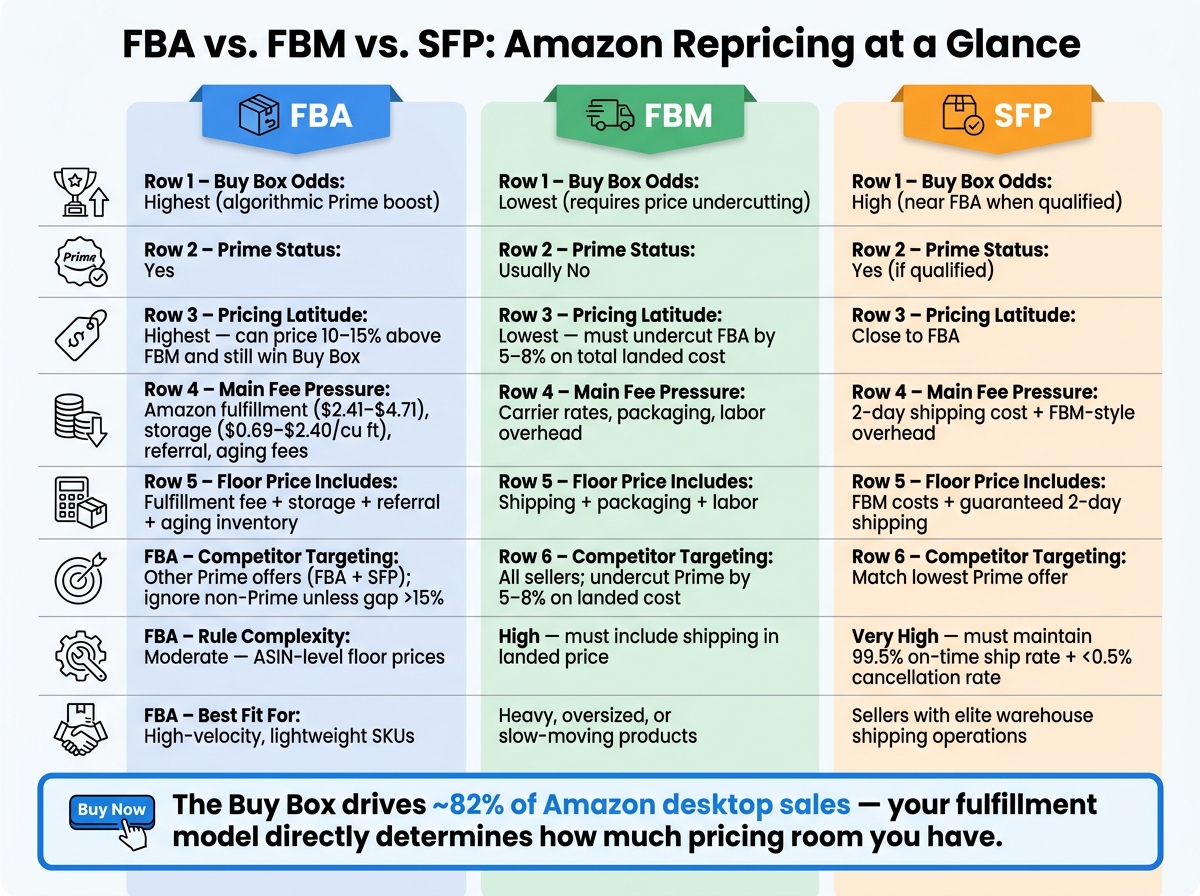
FBA vs FBM vs SFP: Amazon Repricing Comparison Chart
Which Amazon Fulfillment Method is Affordable? Choose between FBA vs SFP vs FBM | AMZ Prep
sbb-itb-e2944f4
Quick Comparison
| Factor | FBA | FBM | SFP |
|---|---|---|---|
| Buy Box odds | Highest | Lowest | High |
| Prime status | Yes | Usually no | Yes, if qualified |
| Price room | Often highest | Usually lowest | Close to FBA |
| Main cost pressure | Amazon fees | Shipping and overhead | 2-day shipping cost |
| Rule setup | ASIN-level floors | Landed-cost logic | Prime-aware rules + tight metric control |
So if you sell fast-moving, light products, FBA often gives you more room to hold price. If you sell heavy or slow-moving items, FBM may protect margin better. And if you can ship at Prime level from your own warehouse, SFP sits in the middle.
FBA vs. FBM vs. SFP: Side-by-Side Overview
These three fulfillment models shape repricing in very different ways. FBA tends to have the strongest Buy Box position, FBM usually gives sellers lower overhead, and SFP lands somewhere in the middle.
Buy Box Odds, Fees, Speed, and Rule Complexity
When you look at repricing, the clearest gaps show up in four areas: Buy Box odds, fee pressure, shipping speed, and how hard the rules are to manage.
| Factor | FBA | FBM | SFP |
|---|---|---|---|
| Buy Box Odds | Highest; receives an algorithmic boost | Lowest; requires significant price undercutting | High; nearly identical to FBA when qualified |
| Pricing Latitude | Often allows higher pricing than FBM | Typically must undercut FBA by 5–8% on total landed cost | Similar to FBA pricing power |
| Ship Speed | Amazon-guaranteed Prime, usually 1–2 days | Seller-controlled; usually slower | Must meet the 2-day Prime promise |
| Fee Pressure | High (fulfillment, storage, and weight fees) | Low (avoids Amazon storage and fulfillment fees) | Moderate (seller handles shipping costs) |
| Rule Complexity | Moderate (ASIN-specific floor prices needed) | High (shipping-cost assumptions required) | Very high (99.5% on-time ship rate required) |
That combination has a big effect on how much pricing room each model gives you. SFP gets you Buy Box odds that are close to FBA, but without the storage fee hit that comes with FBA. The tradeoff is that you have to keep up the required on-time shipping rate and cancellation thresholds from your own warehouse, which makes it the toughest model to run from a repricing standpoint.
How Each Fulfillment Model Changes Repricing
The table shows the headline differences. Here’s what they look like in day-to-day repricing. Your fulfillment model changes three things fast: how high you can push price, how low you can safely go, and how fast your rules need to react.
FBA Repricing Impact
FBA usually gives you the highest price ceiling. In many cases, FBA offers can price 10–15% higher than FBM competitors and still win the Buy Box.
The catch is the floor. With FBA, your minimum price has to cover fulfillment, storage, referral, and aging-inventory fees. That’s why ASIN-level floors tend to work better than one blanket rule across the catalog. A $25 item and a $120 item don’t carry the same fee pressure, so they shouldn’t share the same floor logic.
Inventory depth also changes the play. When inventory cover drops below 30 days, Buy Box share can fall. At that point, it makes sense to ease off aggressive repricing. If stock is getting thin, cutting price too hard can burn through units at the worst time.
FBM Repricing Impact
FBM has less room on the high end because it lacks Prime eligibility. To stay in the fight against Prime offers, FBM sellers usually need to undercut FBA listings by 5–8% on item price plus shipping to win the Buy Box.
That’s why FBM repricing has to look at landed cost, not item price by itself. If your repricer only watches the base price, you can look cheaper on paper while still losing once shipping is added. And if Prime prices move and your rules lag behind, that landed-price gap can open up fast.
The good news is the floor is simpler. For FBM, the main limits come from shipping and overhead, not Amazon fulfillment fees.
SFP Repricing Impact
Seller Fulfilled Prime sits in the middle in an interesting way. It gives you Prime-like pricing room while you still ship from your own warehouse.
But that edge only lasts if your performance stays clean. As of 2026, SFP eligibility requires a 99.5% on-time ship rate and a sub-0.5% cancellation rate. If those metrics slip, price cuts alone won’t bring back Buy Box position. In other words, you can’t reprice your way out of shipping problems.
SFP sellers also need to build actual shipping costs into their floors, since they still handle fulfillment themselves.
These differences set up the floor-price and Prime-aware rules in the next section.
Repricing Rules by Fulfillment Method
Use fulfillment-specific floor prices and Prime-aware competitor filters.
Floor Prices and Shipping-Cost Assumptions
Your floor price sets the lower limit. Competitor targeting decides who you price against. That floor price is the number that matters most in a repricing setup, and it should be worked out per ASIN, not applied as one blanket rule across your whole catalog.
| Cost Component | FBA | FBM | SFP |
|---|---|---|---|
| Amazon fulfillment fee | ✓ (starts at $2.41–$4.71) | ✗ | ✗ |
| Storage fees | ✓ ($0.69–$2.40/cu ft) | ✗ | ✗ |
| Carrier and packaging costs | ✗ | ✓ | ✓ |
| Guaranteed 2-day shipping | ✗ | ✗ | ✓ |
| Internal labor and customer service overhead | ✗ | ✓ | ✓ |
For FBA, the floor needs to cover Amazon’s variable fees. Storage is a good example. Standard-size storage moves from $0.69 per cubic foot from January through September to $2.40 per cubic foot from October through December. So a floor that works in July can be too low in November if peak-season storage isn’t built in.
For FBM, the setup looks simpler, but that’s where sellers often get caught out. Packaging materials, live carrier rates, and internal labor all need to be part of the math. Shipping should be added to the floor.
For SFP, the floor is close to FBM, with one big difference: add the cost of 2-day shipping to the floor.
Competitor Targeting and Prime-Aware Logic
Once the floor is set, Prime status should shape your competitor filter. Then comes the next call: competitor scope. Not every offer should trigger the same repricing move.
| Target | FBA | FBM | SFP |
|---|---|---|---|
| Primary targets | Other Prime-eligible offers (FBA and SFP) | All sellers | Other Prime-eligible offers (FBA and SFP) |
| Filter | Ignore non-Prime unless price gap exceeds 15% | Undercut Prime offers by 5–8% on total landed cost | Match the lowest Prime offer |
| Shipping assumption | Fees fixed per size/weight | Must include shipping in landed price | Must include 2-day shipping cost in floor |
FBA sellers should aim at other Prime-eligible offers, meaning FBA and SFP. In many cases, FBA can sit above FBM pricing and still keep the Buy Box. Chasing a non-Prime FBM seller down the page is often wasted movement.
FBM sellers have the hardest job here. If you can’t beat Prime offers on total landed cost, it makes more sense to target only other FBM offers.
SFP sellers should match the lowest Prime offer.
Choosing the Right Fulfillment Model for Repricing
Which Model Fits Your Pricing Strategy
Once your repricing rules are in place, the last piece is picking the fulfillment model that lines up with your margin target and Buy Box goal.
The short version is pretty simple:
- FBA gives you the most Buy Box leverage
- FBM keeps fixed costs lower
- SFP gives you Prime visibility while you keep control of your own warehouse
FBA makes the most sense for high-velocity, lightweight SKUs. But there’s a catch: Q4 storage fees can squeeze margin fast. That pressure comes from fees, not just fulfillment speed, especially when storage rates jump from $0.69 to $2.40 per cubic foot in October.
That’s the core difference here: cost structure matters as much as delivery speed.
FBM is often the better fit for heavy, oversized, or slow-moving products. In those cases, FBA weight and dimension fees can cut into margin so much that any Buy Box edge may not make up for it. Since FBM offers usually don’t get Prime eligibility, sellers often need to price more aggressively to compete with Prime listings.
SFP falls in the middle. You get Prime visibility without FBA storage fees, but only if your shipping performance stays elite.
Key Takeaways
These tradeoffs point to one rule: price based on the actual cost of your fulfillment model, not the catalog average.
Pick the model that fits your margin structure, your Buy Box goal, and what your operation can handle.
FAQs
Which fulfillment model is best for my products?
The right model comes down to your capacity, product type, and margins.
FBA often works well for small, higher-value items that sell fast. It can help with Buy Box odds, and it takes logistics and customer service off your plate.
SFP can deliver similar Buy Box performance if you can meet its strict requirements.
FBM gives you the most control. It may be a better fit for large or heavy products if you can keep pricing and shipping competitive.
How do I set a floor price for each model?
Start by calculating your true landed cost: cost of goods sold, Amazon referral fees, fulfillment fees, and advertising costs. Then set a floor price that protects at least a 15%–18% gross margin per ASIN.
Costs can shift a lot based on category, weight, and size tier. So don’t use one blanket number across your catalog. Calculate the floor price for each model on its own.
Before you lock in pricing, use the Amazon FBA Revenue Calculator in Seller Central to confirm your current cost data.
When should I target Prime offers in repricing?
Target Prime offers when your listing is FBA-enrolled or SFP-certified. Prime badges have a big effect on Buy Box results.
Why does that matter? FBA and SFP tell shoppers, and Amazon, that your shipping is fast and dependable. That often gives you more room on price.
In many cases, you can price 10% to 15% higher than FBM offers and still stay competitive. The goal isn’t to undercut by default. It’s to protect margin while keeping sales moving.
That’s where automated, velocity-aware repricing helps. Instead of dropping your price every time the market shifts, it adjusts based on sales pace and demand so you can hold stronger prices when the listing can support them.